A full Arabic course online takes you from zero knowledge to real, functional Arabic — reading, writing, listening, and speaking. Not one skill. All four. This guide shows you exactly what that looks like, how long it takes, and how to choose a program that actually delivers results.
If you think this is just another ordinary article like any other you read, you’re mistaken. Keep reading until the end, especially the second-to-last paragraph, and then give your opinion. This article shows you what a complete course with a successful, experienced teacher means, and how it makes learning the language that everyone fears easier—not because it’s bad, but because they say it’s difficult. With us, the difficult becomes easy. Keep reading and see, champ!
What Most People Do Wrong When They Try to Learn Arabic Online

Meet James.
He spent two years trying to learn Arabic online. Two full years. And at the end of it, he couldn’t read a single paragraph fluently, write a coherent sentence, or hold a basic conversation.
Here’s what he actually did:
- 6 months on Duolingo (learned the alphabet and maybe 300 words)
- 4 months watching random YouTube tutorials
- 8 months using a conversation app (basic phrases, zero reading ability)
- 6 months grinding through a grammar textbook (theoretical knowledge, couldn’t speak)
Sound familiar?
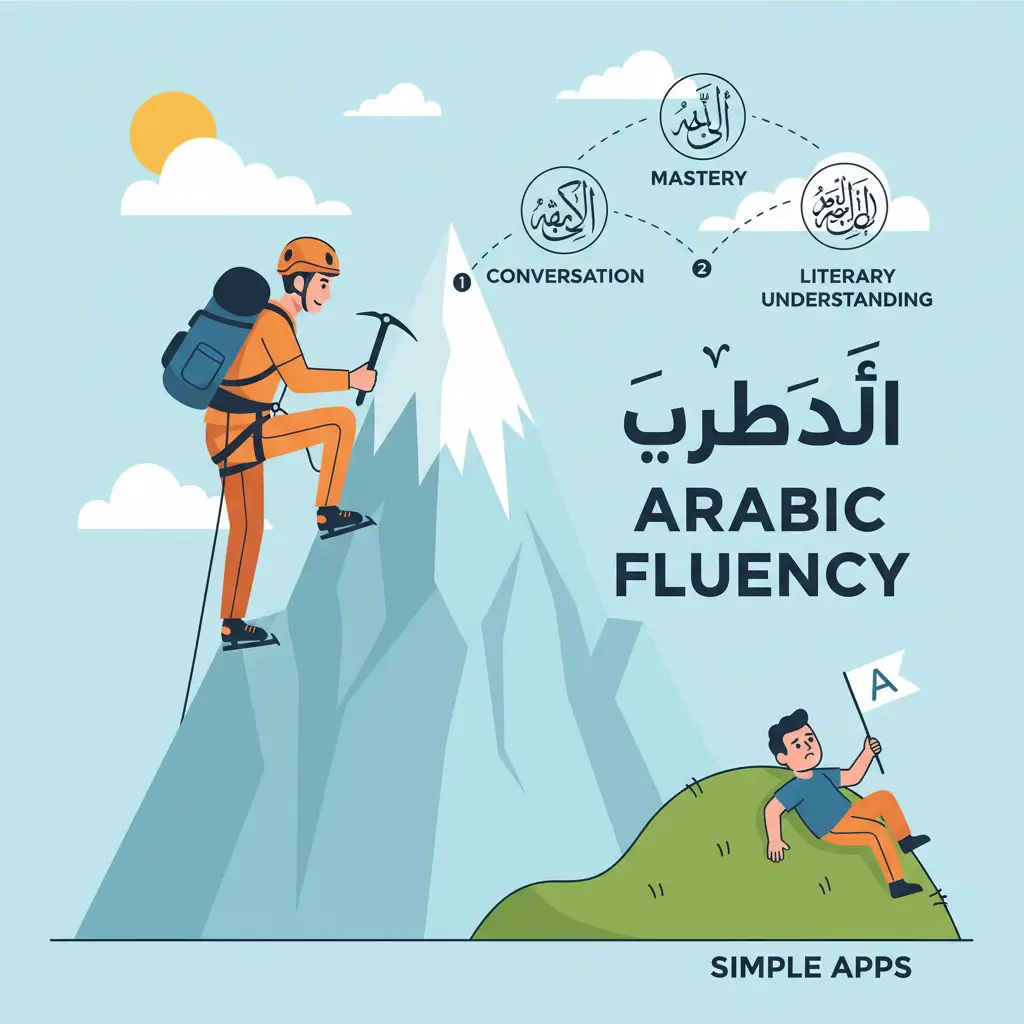
The problem wasn’t James. The problem was fragmented learning. He’d collected pieces — but never built the whole picture. Swiss cheese knowledge. Massive gaps everywhere.
Then he found a full Arabic course online. Structured. Systematic. All four skills, built together from day one.
18 months later? He was reading Arabic newspapers. Writing professional emails. Understanding Al Jazeera broadcasts. Having real conversations in formal Arabic.
Same person. Different approach. Completely different results.
That’s what this guide is about.
What Does “Full” Actually Mean in a Learn Arabic Online Course?

Here’s the thing — “full” doesn’t mean “a lot of content.”
Plenty of programs advertise “100+ video lessons!” or “Complete Arabic in one package!” But they’re missing the point. And often, half the skills.
A full Arabic course online means:
- All four skills: reading, writing, listening, AND speaking
- Complete proficiency range: beginner through advanced
- Systematic progression — not random lessons thrown together
- Grammar, vocabulary, and culture integrated (not isolated)
- A realistic timeline (18–36 months, not “fluent in 90 days”)
- Regular assessments with real feedback
- Live teachers — not just pre-recorded videos
- Actual homework, correction, and practice
Not full: “Arabic Grammar Course” — just grammar, no speaking. Not full: “Conversational Arabic” — just phrases, no literacy. Not full: “Arabic Reading Course” — just reading, no writing or speaking.
Full = complete. A-to-Z. Everything you need, nothing you have to supplement elsewhere.
The 8 Components Every Full Arabic Course Needs
1. Alphabet & Phonology (Weeks 1–8)
All 28 Arabic letters. All four positional forms. The vowels. The sounds that don’t exist in English — ع، ح، خ، and others. Reading fluency as a foundation, not an afterthought.
If a course skips this or rushes it, you’ll spend the next year guessing at words you can’t sound out properly.
2. Systematic Grammar (Months 1–24)
Beginner → Elementary → Intermediate → Advanced. In that order. Always.
Tenses, case system, verb patterns, construct state, complex syntax. Each building on the last. You can’t jump to verb conjugation if you don’t know noun patterns. A full course doesn’t let you.
3. Progressive Writing (Ongoing)
Copying letters → writing sentences → building paragraphs → composing essays → professional documents.
Every week. With feedback. Not just watching — producing.
4. Listening Comprehension (Ongoing)
Slow, clear teacher speech first. Then structured dialogues. Then simplified news. Then authentic Arabic media — Al Jazeera, lectures, discussions.
Daily. 15–30 minutes minimum.
5. Speaking Practice (Every Session)
Pronunciation drills → simple exchanges → full discussions → formal presentations.
Not once a month. Every. Single. Session. Live interaction with a real teacher who corrects you in real time.
6. Vocabulary: 3,000–5,000 Words (Progressive)
High-frequency words first. Organized thematically. Built using the Arabic root-pattern system so one root unlocks dozens of words. Spaced repetition built in.
7. Cultural Understanding (Integrated Throughout)
Arab history, culture, contemporary issues, regional awareness, media literacy. Not a separate module — woven into every level.
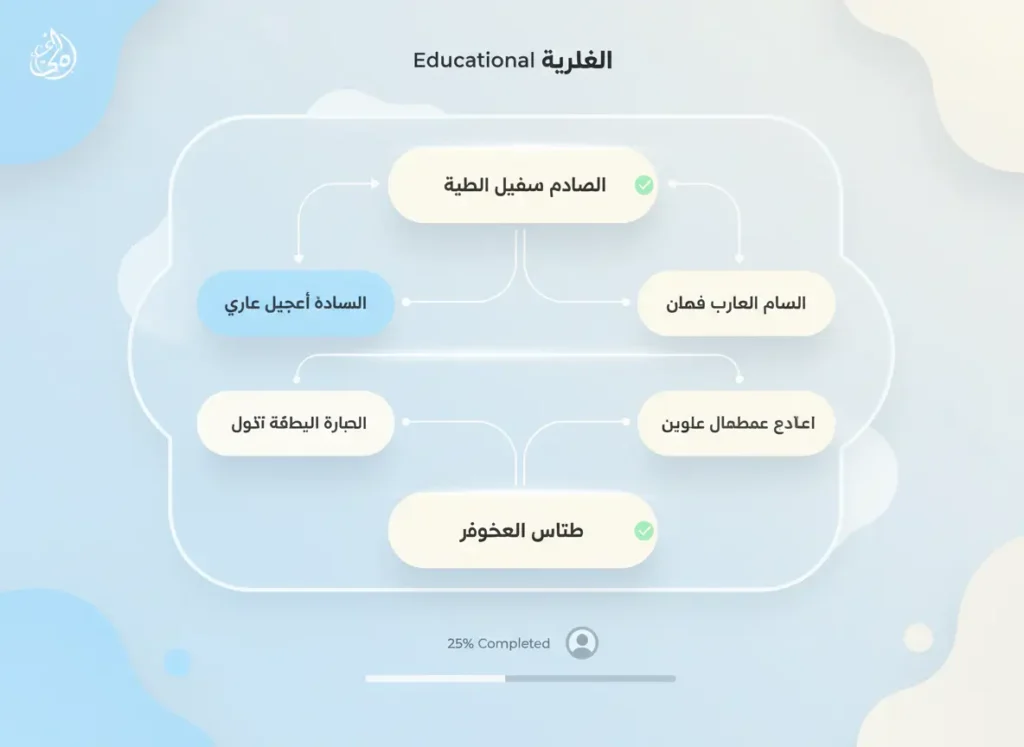
8. Regular Assessment & Tracking
Placement test. Bi-weekly quizzes. Monthly progress reports. Level-completion exams. Clear benchmarks showing where you are and where you’re going.
How to Learn Arabic Online: The Realistic Timeline

Honest answer: a full Arabic course takes 18 to 36 months.
Not 3 months. Not 6 months. If a program promises fluency in 90 days, it’s lying.
But here’s what the journey actually looks like:
Level 1: Absolute Beginner (Months 1–4)
Focus: Alphabet, pronunciation, basic grammar, simple sentences
By the end:
- Reading voweled Arabic texts
- Writing simple sentences
- Understanding slow, clear Arabic speech
- 300–500 words in vocabulary
- Basic greetings and questions
Time needed: 5–8 hours per week
Level 2: Elementary (Months 5–9)
Focus: Grammar expansion, simple authentic texts, real conversations
By the end:
- Reading children’s books and adapted materials
- Writing short paragraphs and personal messages
- Following simple dialogues
- 1,000–1,500 words
- Describing daily life
Time needed: 6–10 hours per week
Level 3: Intermediate (Months 10–18)
Focus: Complex grammar, authentic materials, extended communication
By the end:
- Reading simplified news articles
- Writing essays and formal emails
- Understanding slow news broadcasts
- 2,500–3,500 words
- Holding real discussions
This is functional proficiency. You can use Arabic in real-world contexts.
Time needed: 8–12 hours per week
Level 4: Advanced (Months 19–36)
Focus: Sophistication, nuance, near-native expression
By the end:
- Reading novels, academic papers, and complex journalism
- Writing research papers and professional documents
- Understanding Al Jazeera at full speed
- 4,000–6,000 words
- Formal presentations and complex arguments
Time needed: 10–15 hours per week
Study Intensity Options
| Intensity | Hours/Week | Timeline | Best For |
|---|---|---|---|
| Casual | 3–5 hrs | 36–48 months | Hobbyists |
| Moderate | 6–10 hrs | 24–30 months | Working professionals |
| Intensive | 12–20 hrs | 18–24 months | Career requirements |
| Immersion | 25–40 hrs | 12–18 months | Full-time students |
Honestly? Moderate intensity is the sweet spot for most people. Sustainable and effective.
Can I Learn Arabic Online Quickly? Let’s Be Direct.

This is one of the most searched questions out there. And the answer is: yes and no.
Can you learn Arabic online faster with the right approach? Absolutely.
Can you become fluent in a few months? No. And anyone telling you otherwise is selling something.
Here’s what “fast” actually means in Arabic:
- Fast = 18 months to functional intermediate with consistent daily study
- Slow = 3+ years piecing together apps, YouTube, and grammar books
The biggest time-waster isn’t Arabic itself. It’s switching between programs, starting over, or spending months on one skill while ignoring the others.
What actually speeds up your progress:
- Live classes with qualified native teachers (not just videos)
- Studying all four skills together, from day one
- Daily contact with the language — even 20 minutes beats one 2-hour weekend session
- Getting corrections immediately, before bad habits form
One more thing. Arabic has a deep root system. Once you understand it, you stop memorizing individual words and start recognizing patterns. كَتَبَ (wrote), كِتَاب (book), مَكْتَبَة (library), كَاتِب (writer) — same root. That system, taught properly, actually makes vocabulary acquisition much faster than people expect.
Learn Arabic Online Classes: What to Look For

Not all online classes are equal. Not even close.
Here’s what separates a class that works from one that wastes your time:
Native, qualified teachers. Graduates of Al-Azhar or other recognized Arabic institutions. Not just native speakers — teachers with actual credentials and experience teaching Arabic to non-native adults. Big difference.
Small groups. Maximum 5–8 students per class. You need to actually speak in every session. You can’t do that in a group of 25.
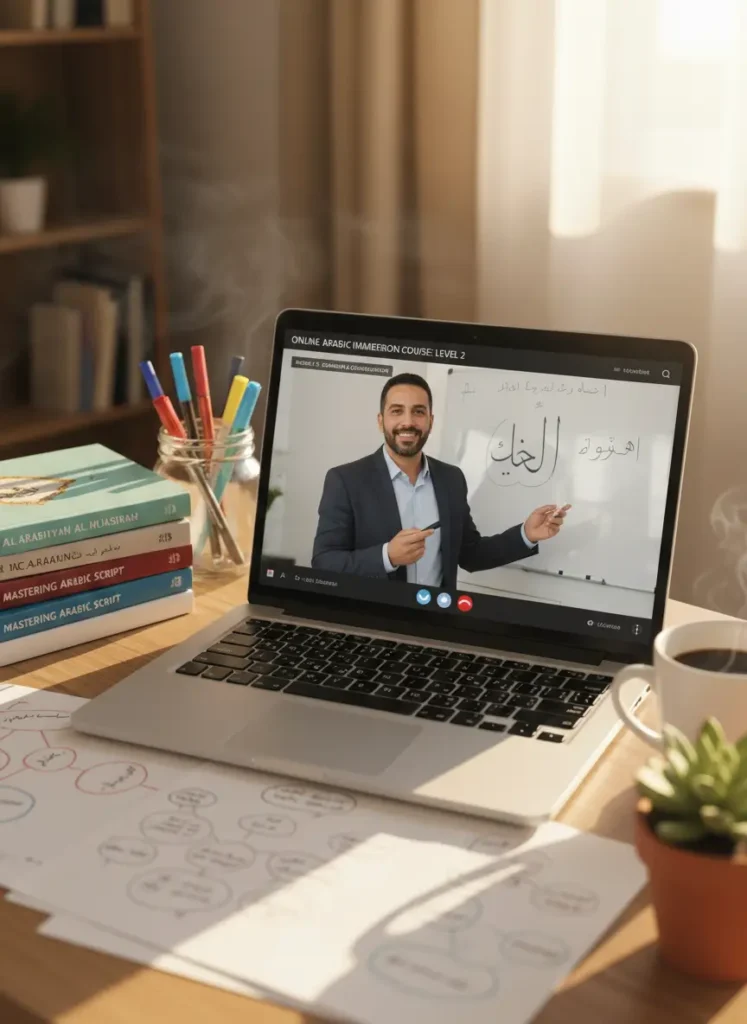
Live sessions, not just recordings. Pre-recorded videos can’t give you feedback. They can’t correct your pronunciation mid-sentence. They can’t answer your question when you’re confused. Live instruction is non-negotiable for real progress.
Regular speaking practice. Every single session. Not occasionally. Not “we’ll do speaking next month.” Every class.
Consistent feedback loop. Homework assigned. Homework corrected. Errors explained. Progress tracked. If a course doesn’t do this, it’s not a full course — it’s a video library.
Learn Arabic Online for Beginners: The Right Starting Point
If you’re a complete beginner, here’s the truth: the first 4–8 weeks are everything.
Master the alphabet, and the whole language opens up. Struggle through it, or skip parts, and you’ll be guessing at words for years.
A good beginner course starts here:
Week 1–2: Letters, sounds, and how Arabic script works (right to left, connected letters, four forms per letter)
Week 3–4: Short vowels, long vowels, reading simple words
Week 5–8: Reading full sentences, introduction to basic grammar, first vocabulary set
By week 8, you should be reading voweled Arabic text — slowly, but correctly. That’s the foundation everything else is built on.
What beginners often get wrong:
- Jumping straight to phrases without learning to read (you’ll be lost in any real context)
- Relying only on transliteration (crutch that slows you down long-term)
- Skipping pronunciation work (mistakes fossilize quickly — fix them early)
- Trying to learn dialect and Modern Standard Arabic simultaneously (pick one, usually MSA first)
10 Ways to Learn Arabic Online More Effectively
Here’s what actually works — and what most people skip.
1. Study every day, not just on class days. Even 20 minutes. Consistency beats intensity. Your brain consolidates language while you sleep, but only if you give it daily input.
2. Read out loud. Always. Reading Arabic silently is half the practice. Your mouth needs to learn the language too.
3. Use the root system intentionally. When you learn a new word, ask: what’s the root? What other words share it? One root = potentially 10–15 related words.
4. Expose yourself to real Arabic media early. Even if you understand nothing at first. Al Jazeera, Arabic YouTube channels, Arabic podcasts. Your ear needs time to adjust to natural speech.
5. Practice writing every week. Don’t just read. Write sentences. Write paragraphs. The act of producing Arabic reinforces everything else.
6. Focus on Modern Standard Arabic first. It’s standardized, widely understood, used in all formal contexts, and the foundation for dialects. You can add a dialect later.
7. Get corrections in real time. This is why live classes matter. A recorded video can’t tell you that you’re mispronouncing ع every single time.
8. Track vocabulary with spaced repetition. Anki, or whatever system works for you. But track it. 3,000 words takes time — you need a system.
9. Don’t switch programs constantly. Pick a comprehensive course and stick with it. The grass is not greener on the other app. Switching resets your momentum and creates gaps.
10. Set a realistic goal with a deadline. Not “I want to learn Arabic.” Instead: “By month 12, I want to read a simple news article without a dictionary.” Specific. Measurable. Motivating.
Full Course vs. Fragmented Learning: Real-World Comparison
Let’s look at two real scenarios.
Scenario A: The Fragmented Approach
- 3 months Duolingo (alphabet, 500 words)
- 3 months grammar textbook (theoretical only)
- 3 months conversation app (basic phrases)
- 3 months YouTube (random lessons)
Total time: 12 months. Total cost: around $200.
Result: Fragmented knowledge. Can’t read paragraphs fluently. Can’t write coherent texts. Can’t hold real conversations. Gaps everywhere between the pieces.
Scenario B: The Full Course Approach
- 18 months comprehensive structured course
- All skills developed systematically from day one
- Regular practice, assessment, and feedback
- Grammar, vocabulary, and culture integrated throughout
Total time: 18 months. Total cost: $5,000–$8,000.
Result: Functional intermediate proficiency. Reads newspapers. Writes professional emails. Understands news broadcasts. Converses confidently. No major gaps.
The fragmented approach also has specific failure modes worth naming:
Problem 1 — Missing foundations. A YouTube video teaches future tense but assumes you know present tense perfectly. You don’t. Confusion, frustration, giving up.
Problem 2 — Skill imbalances. Spent months on reading, zero speaking practice. You can read but can’t communicate. Feels like wasted effort.
Problem 3 — No systematic review. You learn something in month 1 and never encounter it again. By month 6, it’s gone.
Problem 4 — No quality control. A free video by someone who isn’t a trained teacher. You learn incorrect pronunciation. It fossilizes.
A full course eliminates all four problems through systematic, quality-controlled instruction. That’s the difference.
How to Choose a Full Arabic Course Online: The Checklist
Before you enroll anywhere, ask these questions.
Does it cover all proficiency levels? Beginner through advanced. If it stops at intermediate, it’s not a full course.
Does it develop all four skills? Reading, writing, listening, and speaking. If any one of these is absent, keep looking.
Are teachers native speakers with qualifications? Not just native Arabic speakers — teachers with formal credentials and years of experience teaching Arabic to adults. Ask to see teacher bios.
Is there live instruction? Not just recordings. Live classes with real interaction, speaking practice, and real-time feedback. Hybrid (live + recorded) is fine. 100% pre-recorded is not a full course.
How do they assess progress? Placement test, regular quizzes, homework correction, progress reports. If there’s no assessment system, there’s no accountability.
What’s the realistic timeline? “Intermediate proficiency in 18–24 months” — trustworthy. “Fluent in 3 months” — run.
What’s the total cost, clearly stated? Not just the monthly fee. Total program cost. What’s included. What’s extra. Refund and cancellation policy.
Can you find independent reviews? Not just testimonials on their own website. Google reviews, social media, language learning forums. Real students, real results.
Red flags to avoid:
- “Complete fluency in 90 days”
- $5,000 upfront with no refund policy
- No information about teacher qualifications
- Only anonymous testimonials
- No placement test or assessment system
Rachel’s Story: Zero to Professional Arabic in 24 Months
Rachel was 28, working in humanitarian aid, and needed Arabic for her Middle East NGO work. Zero previous knowledge. Real deadline. High stakes.
She enrolled in a full Arabic course online — $450/month for 24 months, small group of 5 students, three live classes per week.
Here’s what her progress actually looked like:
Month 6: Alphabet mastered, basic grammar solid, 800 words, elementary conversations possible.
Month 12: Reading simple news, writing emails, 1,800 words, basic conversations in real contexts.
Month 18: Reading newspapers, understanding broadcasts, 3,200 words, working proficiency.
Month 24: Professional competency. Reading fluently. Writing reports. Presenting in Arabic. 4,500 words.
Total investment: $10,800. Outcome: Promotion to regional coordinator, $18,000 annual salary increase. ROI: 167% in the first year alone.
Her advice: “Don’t piece together Arabic from YouTube and apps. I tried for 4 months and got nowhere. When I committed to a structured course with qualified teachers, everything changed.”
Frequently Asked Questions About Learning Arabic Online
Is it really possible to become proficient in Arabic entirely online?
Yes — if the program includes live instruction, regular speaking practice, and qualified teachers. Research consistently shows no meaningful difference in outcomes between quality online and in-person programs. The keyword is “quality.” Pre-recorded-only courses don’t work. Live interactive online courses do.
How many hours per week do I need to study?
Minimum 5–8 hours for slow progress. Optimal is 8–12 hours per week (this gets you to intermediate in about 24 months). Fewer than 5 hours and you’ll be studying Arabic for a decade. More than 20 hours per week risks burnout unless you’re a full-time student.
Should I learn Modern Standard Arabic or a dialect?
For most learners, start with Modern Standard Arabic (Fusha). It’s used across the Arab world for reading, writing, news, and formal contexts. It’s also the foundation that makes learning dialects much easier later. If your specific goal requires Egyptian or Levantine Arabic, look for a dialect-focused full course — but MSA first is usually the better long-term strategy.
What’s the total cost of a quality full Arabic course?
Group classes: $250–500/month × 18–24 months = roughly $4,500–$12,000 total. Private lessons: $400–800/month × 18–24 months = $7,200–$19,200. Quality programs in that range are fair. Cheaper usually means cutting corners somewhere. Significantly more expensive should justify the premium clearly.
Can I do this while working full-time?
Yes. Most successful students are working professionals. The keys are a consistent weekly schedule, 8–12 hours of study time (which is manageable), a realistic 24–30 month timeline, and strong personal motivation. Don’t attempt a full-time intensive program while working full-time — that’s a burnout formula.
What if I fall behind or the course isn’t working?
Quality programs offer a trial period (usually 2–4 weeks), a reasonable refund policy, the ability to pause if life circumstances change, and teacher flexibility. Before enrolling, always ask: “What’s your refund policy?” and “Can I try a class before committing?” If they can’t answer these clearly, that’s information.
How do I know if I’m actually making progress?
Good signs: regular assessments showing advancement, ability to do things at month 6 you couldn’t do at month 3, expanding vocabulary, growing confidence with Arabic text, positive teacher feedback.
Red flags: no assessments, constant confusion, no visible improvement after 6 months, inability to apply what you’re supposedly learning.
If you’re not progressing, figure out first whether the problem is course quality or your own attendance and practice habits. Honest self-assessment matters here.
Start Your Arabic Journey Today
The pattern is clear by now.
Half-measures produce half-results. Fragmented learning produces fragmented knowledge. A comprehensive, structured course produces comprehensive, functional Arabic.
What a full Arabic course requires from you:
- Time: 18–36 months of consistent study
- Investment: $5,000–$15,000 for a quality program
- Commitment: 8–12 hours per week
- Discipline: Showing up even when it’s hard
What it gives you in return:
- Reading, writing, listening, and speaking — all four skills, fully developed
- Access to 400+ million Arabic speakers
- Career opportunities requiring Arabic proficiency
- For Muslims: direct understanding of Quranic Arabic
- A skill that compounds in value for the rest of your life
Your action plan:
Week 1: Get clear on your goals. Why do you need Arabic? What’s your timeline? How many hours can you genuinely commit each week?
Week 2: Research 2–3 full courses that meet all the criteria above. Verify comprehensiveness, teacher qualifications, live instruction, and the assessment system.
Week 3: Take trial classes with your shortlisted programs. Experience the teaching style firsthand. Ask hard questions about the curriculum.
Week 4: Enroll. Set your schedule. Commit to at least 6 months before evaluating results.
Not sure where to start? Take the free Arabic level test — it takes 10 minutes and tells you exactly which level is right for you.
At Alphabet Arabic Academy, we’ve built a full Arabic course that covers everything above — from complete beginner to advanced proficiency, 24 months, all four skills, with Al-Azhar-trained native teachers in small groups of maximum 5 students.
88% of our students complete the full program. The industry average is 12%. That gap tells you something.
View our course structure and pricing or book a free trial class and consultation — no obligation, no pressure. Just 45 minutes to see if we’re the right fit.
The best time to start was a year ago. The second best time is now.
بسم الله — In the name of Allah. Let’s begin.